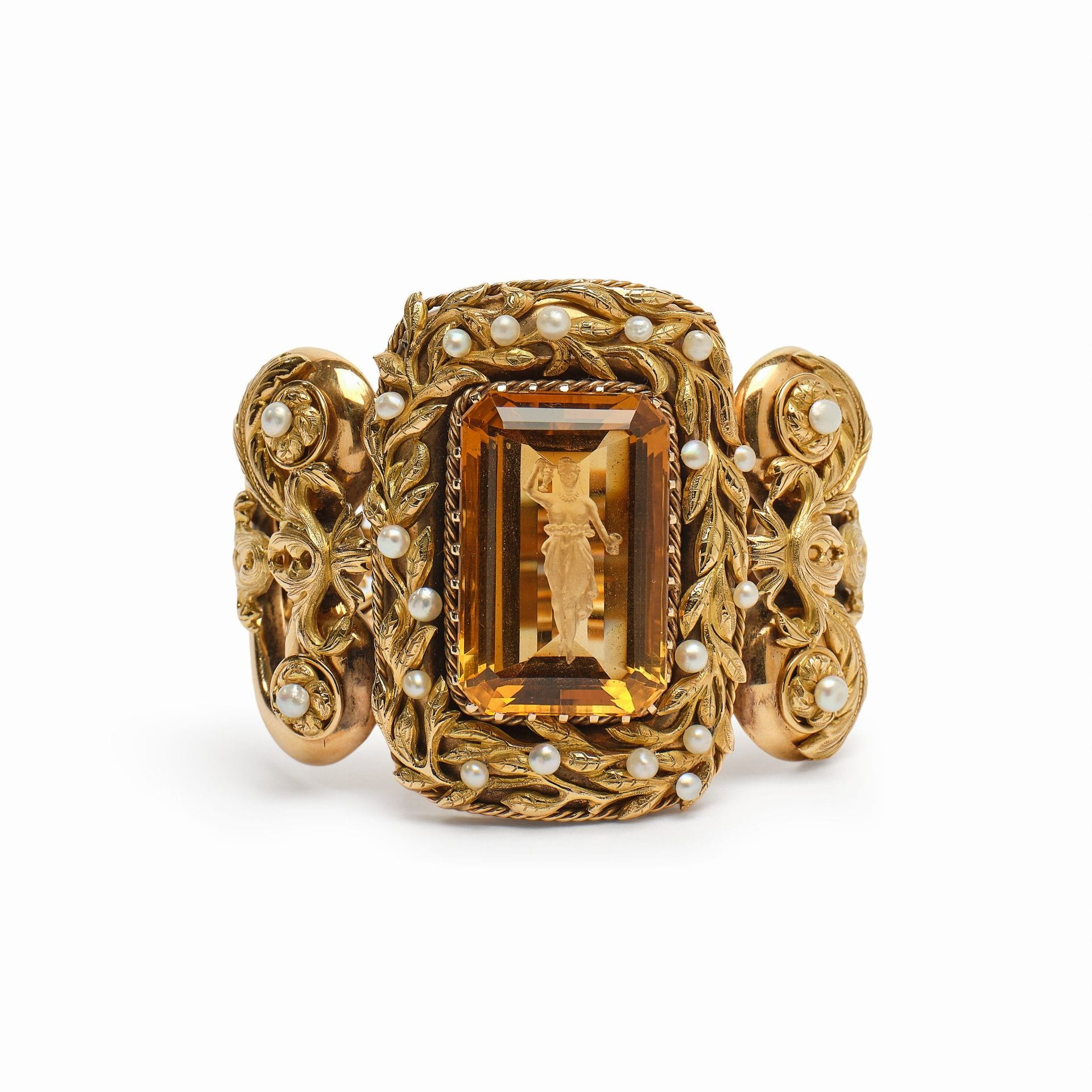
IMPORTANT GOLD AND CITRINE BRACELET, 19TH-CENTURY ITALIAN WORK In yellow gold, the central motif is set with a rectangular, beveled citrine engraved in intaglio with a figure of Hebe, surrounded by openwork, applied, and chiseled foliage studded with pearls; the side elements are openwork with facing volutes decorated with palmettes, acanthus leaves, and rosettes centered with pearls. Mid-19th-century Italian work Unsigned H 6 cm - W 7 cm - D 7 cm Gross weight: 124.5 g The table of the citrine is engraved in intaglio with a depiction of Hebe. The goddess is shown standing, bare-chested, with her hair pulled back and adorned with a necklace. A floral belt holds her drapery in place, which flows in soft folds. With one hand she raises a ewer; with the other, she holds a cup. The daughter of Zeus and Hera, Hebe personifies eternal youth. As the cupbearer of Olympus, she poured nectar and ambrosia for the gods, hence her attributes—the ewer and the cup. After Heracles’ deification, she became his wife. This motif enjoyed great popularity in the 19th century, particularly in Italy, following the famous marble sculptures by Antonio Canova (1757–1822). The figure on the bracelet is part of this neoclassical tradition.
Complete my bid
Place your absentee bid
An absentee bid is a confidential instruction given to the auctioneer. You only pay if you win the lot, and never more than your maximum amount.
Estimate
€8,000 - €12,000
Buyer's premium
30%
IMPORTANT GOLD AND CITRINE BRACELET, 19TH-CENTURY ITALIAN WORK
In yellow gold, the central motif is set with a rectangular, beveled citrine engraved in intaglio with a figure of Hebe, surrounded by openwork, applied, and chiseled foliage studded with pearls; the side elements are openwork with facing volutes decorated with palmettes, acanthus leaves, and rosettes centered with pearls.
Mid-19th-century Italian work
Unsigned
H 6 cm - W 7 cm - D 7 cm
Gross weight: 124.5 g
The table of the citrine is engraved in intaglio with a depiction of Hebe. The goddess is shown standing, bare-chested, with her hair pulled back and adorned with a necklace. A floral belt holds her drapery in place, which flows in soft folds. With one hand she raises a ewer; with the other, she holds a cup.
The daughter of Zeus and Hera, Hebe personifies eternal youth. As the cupbearer of Olympus, she poured nectar and ambrosia for the gods, hence her attributes—the ewer and the cup. After Heracles’ deification, she became his wife.
This motif enjoyed great popularity in the 19th century, particularly in Italy, following the famous marble sculptures by Antonio Canova (1757–1822). The figure on the bracelet is part of this neoclassical tradition.
Sale
Wednesday 16 December・14:00 (Europe/Paris)
Salle 2 - Hôtel Drouot
9, rue Drouot
75009 Paris